








Interviews
The Shape of Speed: A Masterclass in Motion with Dennis Hoyt
If you’ve ever wanted to see what velocity looks like at a standstill, look no further than a Dennis Hoyt original. Each sculpture is a masterclass in gesture, defining the very essence of speed through the marriage of wood and form. Today we dive into Dennis’s journey to see how he transformed a lifelong passion for cars into a world-class legacy of fine art.
Motors
What inspires you to use automobiles as your preferred media of art?
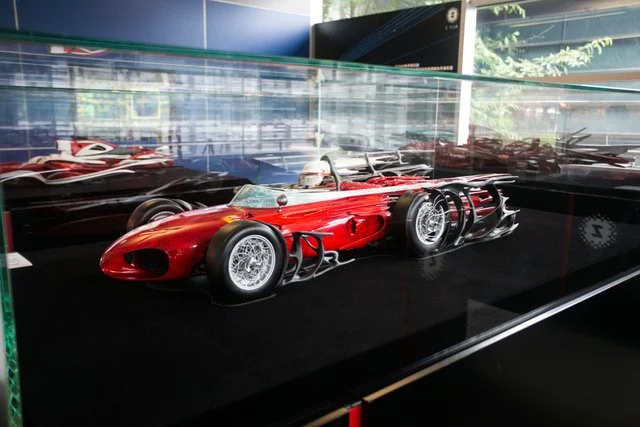
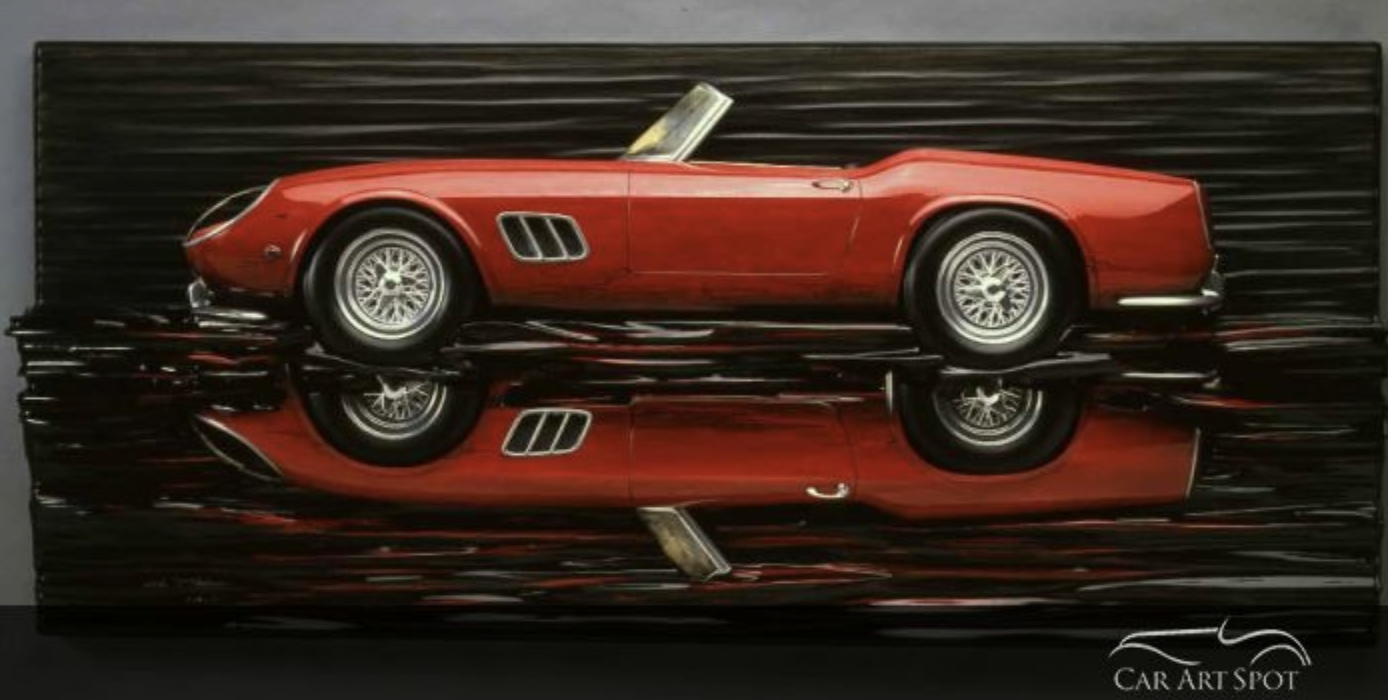
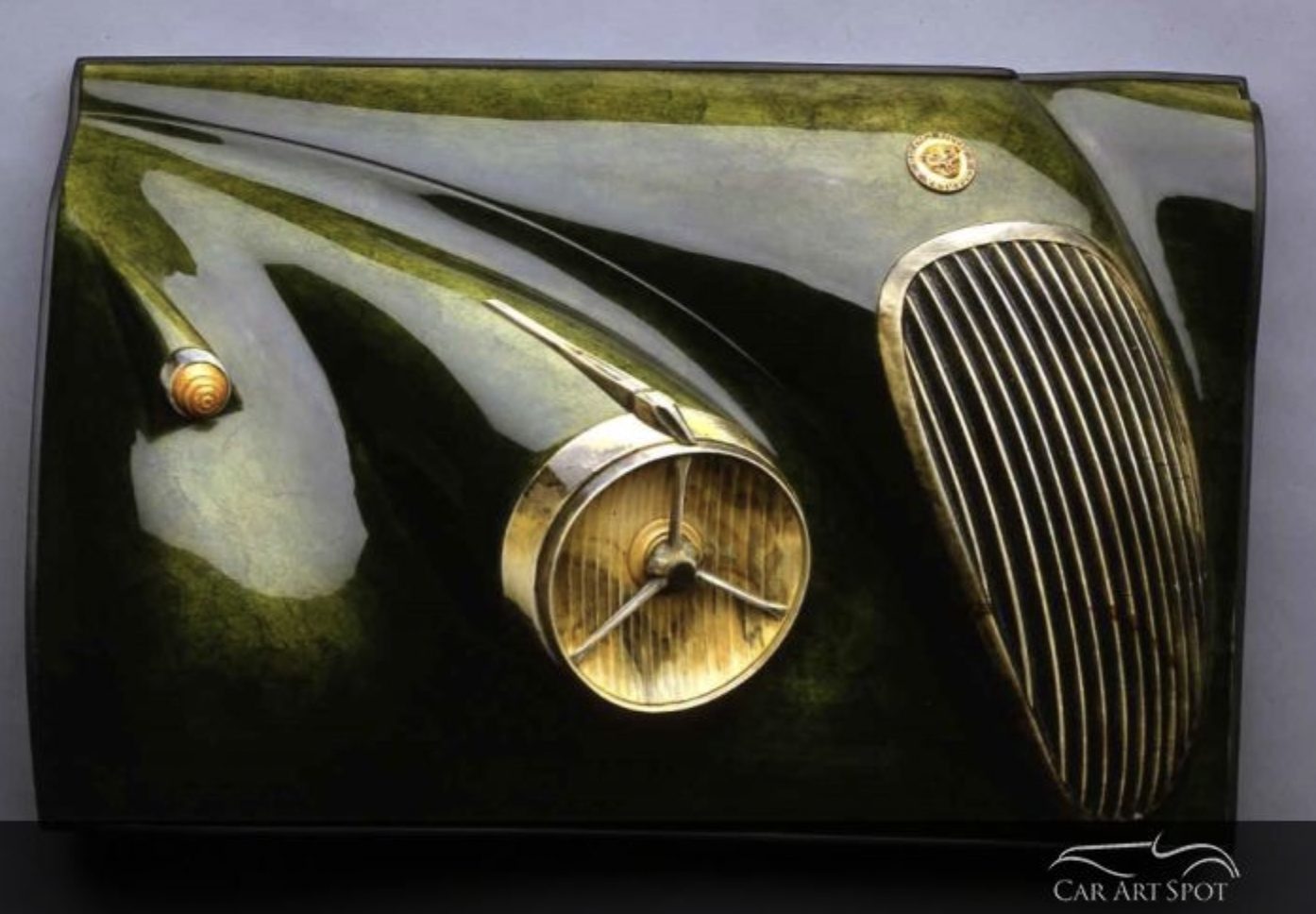
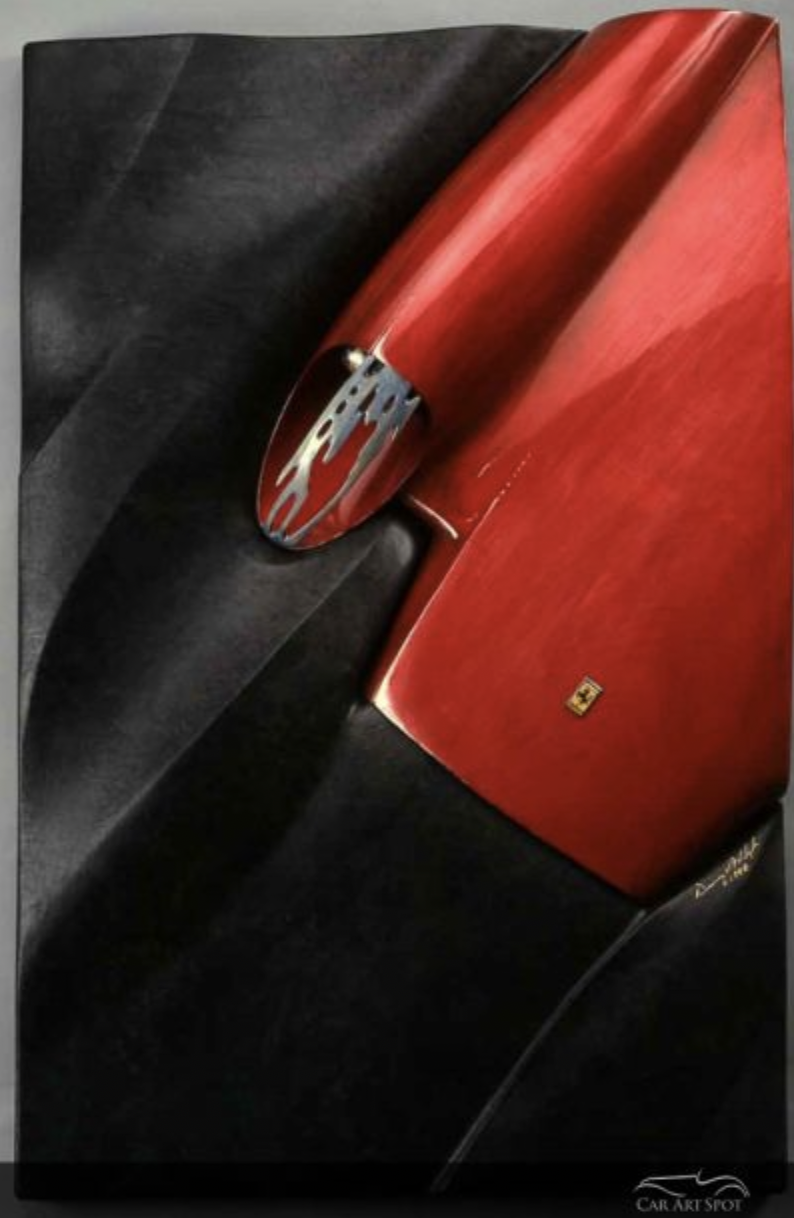
I have always been infatuated with the shapes and lines of the automobile. Even at the age of 3 my parents said I could name every car on the road. The combination of lines, shapes and forms weather it be an overtly aggressive design, a graceful contour, or a combination of the two have fascinated me. When these elements come together in just the right way, such as the marvelous work of the late and truly gifted Sergio Scaglietti I am humbled and inspired by his works. When I create a sculpture of one of his most beautiful works the pontooned fendered Ferrari Testa Rossa and run my hand over the surfaces I can actually understand why this car is so right. It is hard to put into words but I can ‘feel’ that the design is perfect, with just the right flow and surface tension to the adjacent contours. (On a side note, I met and talked with Mr. Scaglietti several years ago at a Ferrari event. I had created a suite of three sculptures of just the hoods of Ferraris’. He came over and talked to me about my work and wanted to sign the bonnet of the Testa Rossa. I could not believe what he wrote: “ El Maestro, Dennis”. Here is one of the most gifted artisans in the world calling me a maestro. I find it hard to believe, as he was the master, and I’m a mere student. I have photos of this signing and will try to find them and send them to you.)
We have learned that you got your first commission from Sir Stirling Moss. Could you elaborate on how that came to be?
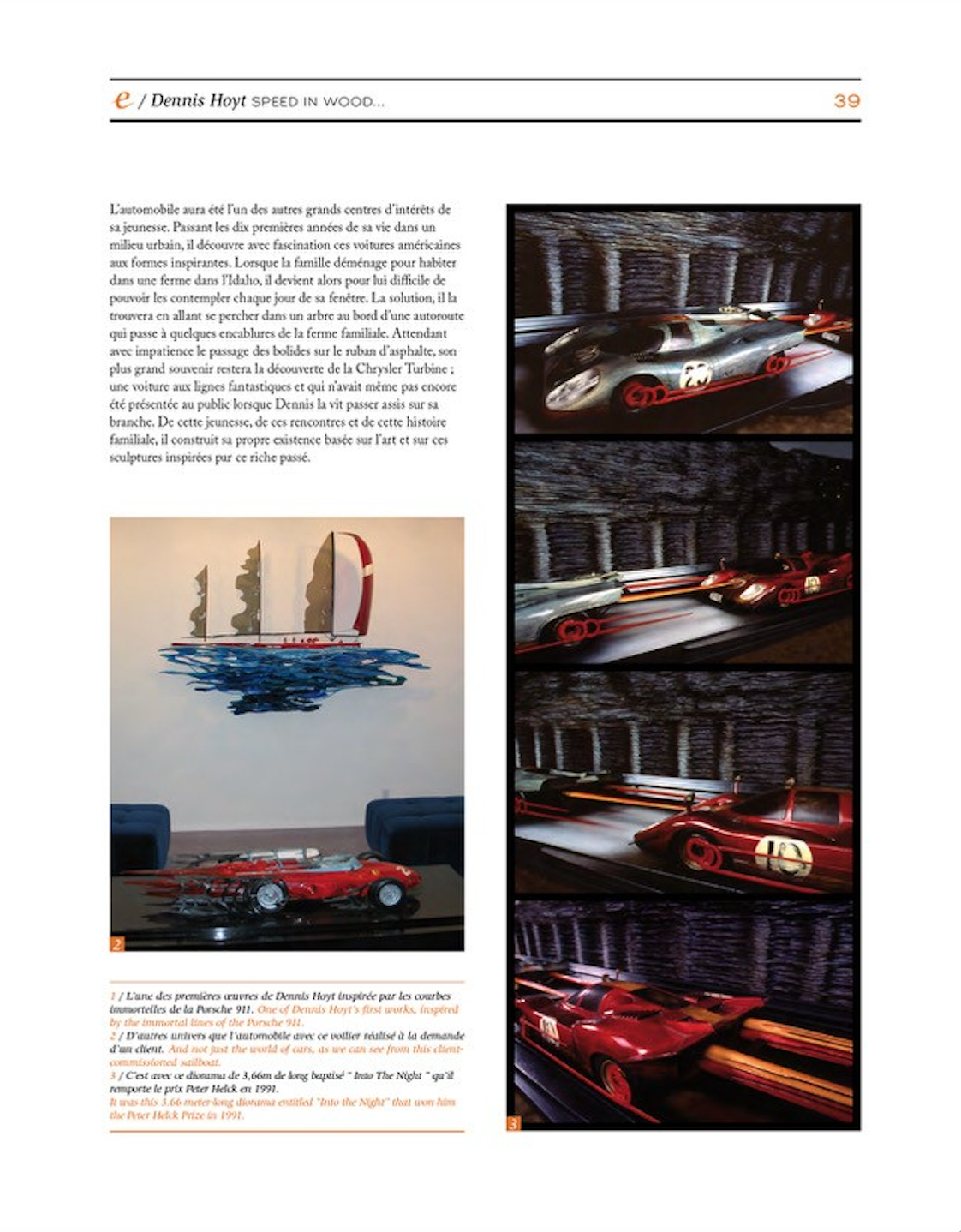
In 1987 I was asked to participate in the annual Automotive Fine Arts Society exhibit at the Pebble Beach Concour d’ Elegance, to be considered for membership. It was during that first showing that I was approached by Sir Stirling Moss. I had created a sculpture of the Maserati ‘Birdcage’ for the exhibit and he informed me that he was the driver who helped the Orsi Family develop the ‘Birdcage’. He was so taken by the sculpture that he commissioned one similar to it with the team colors. (I have a photo of this as well and will send it to you, in addition to a photo of me and him at our first meeting.) Since that time we have become fast friends, and several years later I created another piece of work celebrating his victory at the Mille Miglia, which I signed a special note to him on the piece and he responded by signing a note back to me. I just wished I had it back, but alas, I sold it, along with the Scaglietti signed piece. (I have a photo of Stirling signing this as well.) Currently I am working on a two pieces called ‘Stirling’s Silver’, one of which I will gift to him at Pebble Beach this year.
(Sketch of piece to follow)
How did this passion for creating such radical art pieces come about?
I guess you could call them radical, I never thought about them that way, but upon reflection I guess you could say they are. As the medium I have chosen to work in has not in my opinion been explored to it’s fullest potential. I have always been fascinated with the idea of developing the medium beyond it’s physical limits, to take the perceived notion of what can be done and present it in a unique way as to make the viewer think. To show that if one can think it, one can and must produce it. My main focus is to present something that not only is unique, but engaging as well. I want the viewer to be drawn in, explore the medium, and actually look at the subject matter in an entirely different way. My passion to create something entirely different than anything ever done before is at the core of my being.
Were you always someone with an eye for art or did a particular event spark your interest? Tell us about your story.
Yes, I must say that I always had a passion for art, architecture, and music. The art of Jackson Pollock, Henry Moore, John Chamberlin, the architects Frank Gehry, I. M. Pei, the music of Mozart, Vivaldi, and Bach to name a few, have been inspirational to me. I see one element in all of these and other creative people that is universal, focus. My main focus is multi-faceted in that I am enamored with the thought of speed and motion but at the same time grace and beauty and how do I as an artist present these in such a way it takes the viewer beyond the surface of the piece. To ‘see inside’ the work figuratively as well as intellectually is at the core of my creative process. For example, how does one interpret the ‘thought of speed’ in a three-dimensional form? This question I will continue to explore as long as I am alive.
What makes you choose wood as your preferred material for your pieces?
At a young age, wood was the material that was available to me, as my father was a carpenter by trade, I always seemed to have had an abundant supply of materials. I have always been fascinated with the colors, tactility, and natural beauty to the material. I always favored working in a three-dimensional medium as opposed to the two dimensional mediums. After considering all mediums I analyzed the ‘market’ and came to the conclusion that there was really no one working with wood and developing it beyond it’s recognized limits. No one was taking this medium seriously. I then decided that if I were to develop this beyond it’s recognized limits I would gain recognition faster and be the first, therefore setting myself apart from the rest. I feel I am obligated to present a different perspective on what art can be.
Isn’t there another material that you would consider substituting for wood?
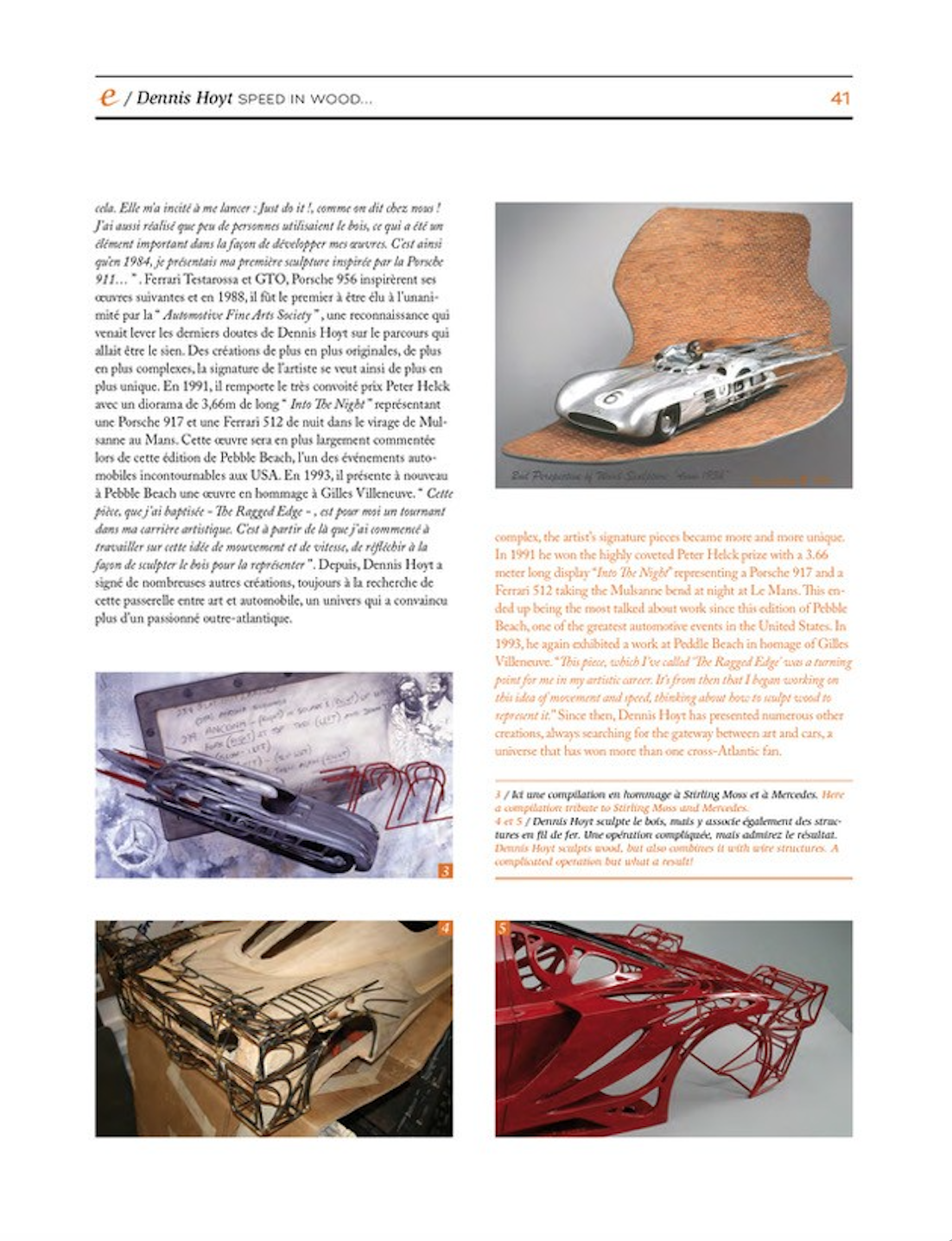
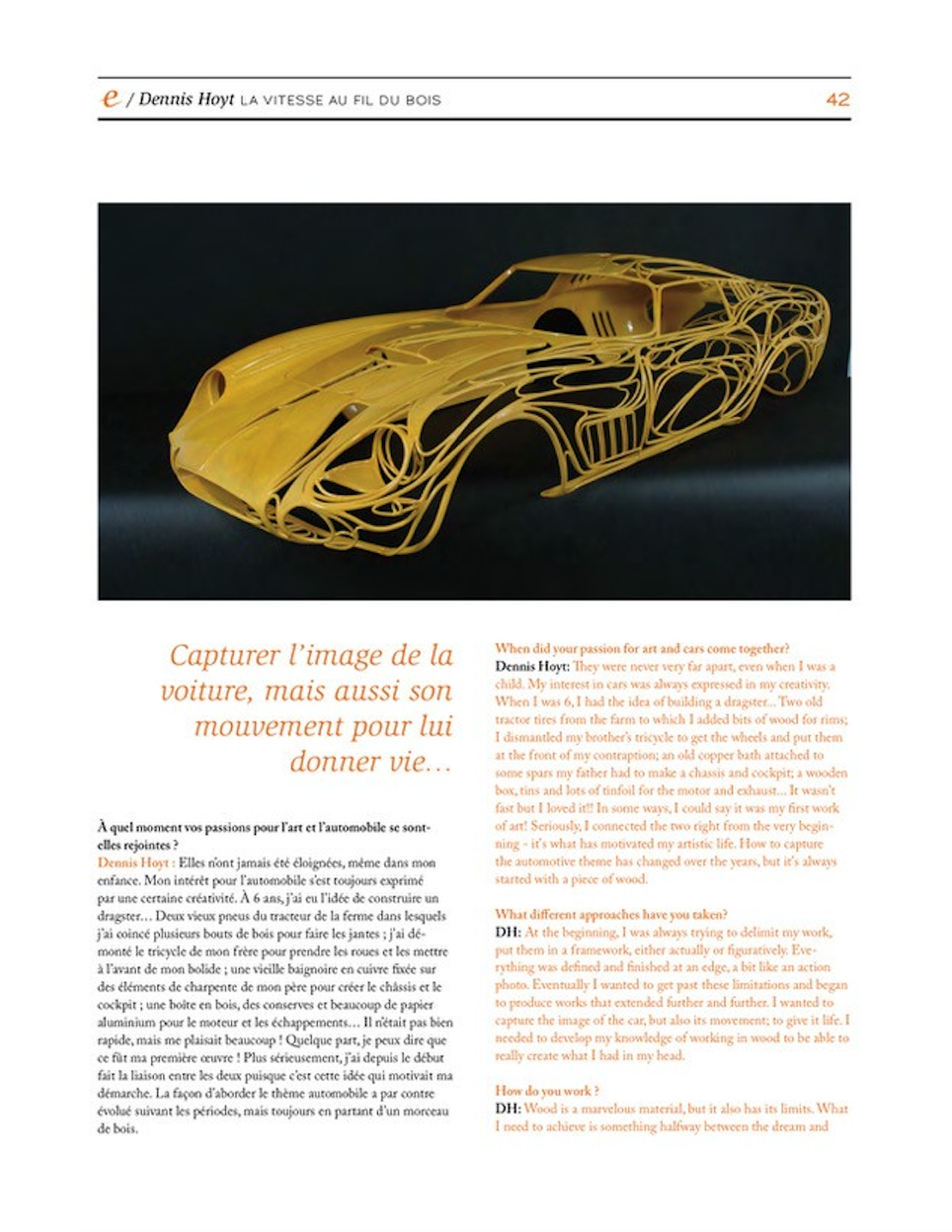
I am intrigued by colored glass and metal although I must admit my expertise in these mediums is limited. I therefore will rely on those who are more accomplished than myself when combining these mediums with my wood. I have been working lately with small steel tubing to enhance my wood pieces. The steel tubing is used to extrapolate the lines or elements of a sculpture. When the wood reaches a point were it becomes to fragile to be practical the steel enables me to further enhance the impression of speed and motion of the piece. I feel that there are quite a few variables that have yet to be developed in this vein. I also see the use of colored glass to further enhance my ideas of speed and motion. As the glass is transparent it can further add to the illusion of speed and motion. I am extremely intrigued by this concept and will try to develop this idea further in the near future.
Could you describe the process of getting a piece finished – from raw material to finished product.
I first contact my material sources weather they are brokers or private individuals who have access to the raw logs that are large enough for a project. I will always try to find the largest diameter logs available. As this has become more and more difficult over the years I have had to expand my search to different areas of the country. The primary wood used in the creation of my pieces is Basswood. It has a very subtle grain pattern, which does not overpower the look of the piece once the dye color is applied. Once the trees are located, the trees are cut and the ends of the logs are sealed and shipped at once.
Upon arrival I immediately start roughing out the shape of car. I must work rather rapidly at this point as the wood is wet and ‘green’. Once the exterior shape is roughed out I MUST immediately hollow out the underside and reduce the thickness of the material to 1-2 inches. By doing this, the wood cures at an even rate and stabilizes. I then can cure the wood in a kiln, this will take anywhere from 1 week to a month at a controlled temperature and humidity setting. Once the wood is cured I begin refining the overall exterior shape of the piece. Removing all wood from areas such as windshield or other glass areas, and any other openings in the car.
Some openings require steel reinforcement to protect the integrity of the piece and the particular opening such as the ‘A’ pillar of the windscreen. Once all the potentially fragile areas are reinforced the excess wood is removed from underside of the sculpture to reduce weight and enhance the overall look of the piece.
All the ancillary pieces are carved and fitted to the main structure. All the wood is then bleached with a two-part bleach. This bleaching process does a couple of things, 1. Cleans and removes all surface residue that might have occurred during handling, and 2. Turns the wood white thus enabling the surface of the wood to reflect the true color of the dyes when applied.
Once all the wood is bleached the coloring process begins. Dyes are mixed and then applied in various ways to achieve the desired effect of the sculpture. After the dyes have dried the wood is ready for multiple coats of clear sealer. Carefully sanding between coats of sealer so as to leave a smooth finish. Once the final coats of sealer have cured the piece is polished and ready assembly and delivery.
It goes without saying that you are an automotive enthusiast. Does your passion for cars span out from art pieces to areas such as motorsport or actual cars in general?
I am an avid fan of Formula 1, Le Mans, Sports Car racing, and all exotic automobiles, Ferrari, Lamborghini, Bugatti, etc. My interest encompasses all aspects of the automotive world. Racing drivers both past and present, I feel honored to know Phil Hill, Sir Stirling Moss, Sir Jackie Stewart Sir David Richards and others through the years. I follow all the new design directions and technologies that are becoming more prevalent with every passing year. I really appreciate some of the classic designs of the past especially those of the late Mr. Sergio Scaglietti, and Mr. Sergio Pininfarina. I feel honored to have met them as both of them have a piece of my work. I am deeply honored to know and to have known these men.
You are an artist that creates every automotive art form that catches your eye. Having said that, what kind of car do you drive?
I wished I could create every automotive art form that catches my eye, but unfortunately there is never enough time. It seems that there is always something I want to try, but client obligations and exhibits must take precedence. As I tell people, so many ideas, so little time.
You have fashioned numerous automotive artifacts; which was the most challenging to do so and why?
I think the most challenging pieces are those that challenge the idea of speed and motion. How do I interpret speed more effectively? To make it not only intense and immediate but also show the passion of those involved. As of late I have become more and more obsessed with the genius of the great drivers, and how they set themselves apart. How do I as an artist convey that passion and genius that they possess in a three-dimensional form? I am now more than ever convinced that it is my obligation to capture and elicit all the drama and pathos involved with taking an automobile to the limit. To give the viewer an immediate sensation of all that is involved when one is at the edge, to make them STOP and think. To that end I am working on a piece that I am very passionate about and which is the first Formula One race of Ayrton Senna, 1984, at Monaco. In the driving rain he passed all and would have passed Prost had not the race been stopped because of the rain. On that day he gave notice to his brilliance. This piece is not completed and will take another 5 to 6 months to complete. It will be a rather simple piece in concept but extremely hard to produce in wood. Once completed this piece will have to be encased in a glass box as it will be too fragile to be open to the elements. I CAN see this in my mind’s eye though as a metal outdoor piece on a 1:1 scale or larger.
Of all the pieces that you have created over the years, which are you most fond of, or keep close to your heart?
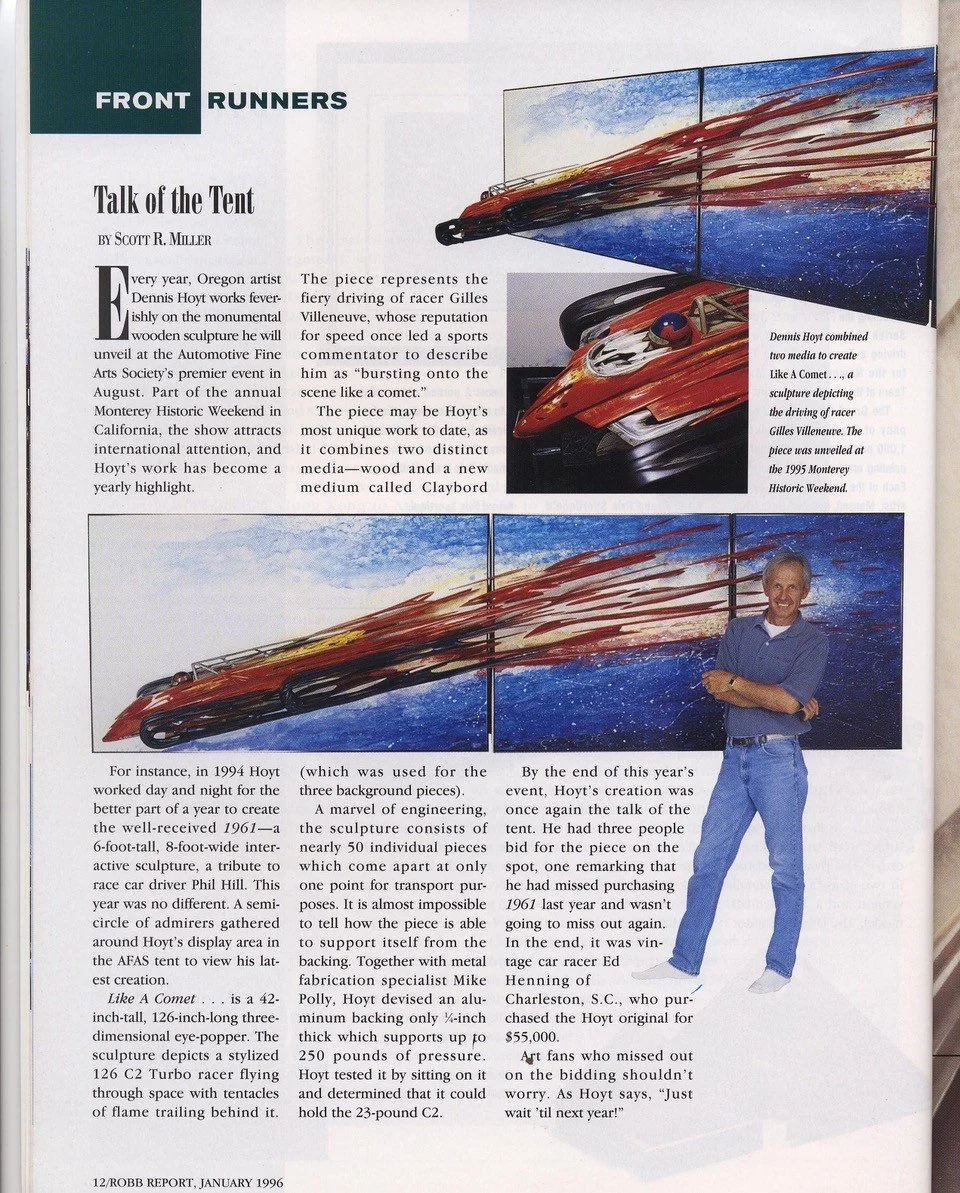
I believe it has to be my very first impressionistic piece, ‘The Ragged Edge’. It represented the last moments of the late Gilles Villeneuve in the Ferrari 126c2. It was said that he always drove “on the ragged edge”, and this was my idea of how to present this as a sculpture. If I could get it back I would.
(I will send photos of this piece)
Big
You seem to believe that art doesn’t have to be a literal translation. How abstract are you willing to go with your art pieces?
The answer to that is: all the way, by that I mean I want to explode the preconceived notion of what automotive art is. I want to bridge the gap between automotive art and art. I firmly believe that art is more than just a literal translation of the subject matter, but rather, an individuals interpretation of said subject matter. The value of art, as I see it is in this interpretation, that is what makes art, art. If we define ourselves with one perspective we stagnate. When I talk to students for example I always leave them with this thought: One should NEVER think you are the best, but ALWAYS try to BE the best. I always tell the students, “Never give up, Never give up”. I love challenging the youth of today many of whom think they have seen it all, but upon viewing my work, they stop and look with awe. To make them realize they have not seen it all.
I want to explore the idea that the viewer should actually become part of the art, to be physically involved with the created piece. Imagine if you will a life size F1 car blurred at speed, that you could actually sit in and become one with the art at speed. I want to explore the idea that a car can become fragmented and still have elements that upon closer inspection reveal the true subject matter, and therefore involve the viewer even more. I want to explore the idea that speed is transitory as life is transitory. I do not want to ‘contain’ my ideas by what I have done, but always look for new ways to express my imagination, to constantly question what I have done, and what I have not done with regard to my art.
How would you say that your passion for art translates into a full time profession? (description of initial start-up)
Automobiles have always been a passion of mine since I was a young boy. As long as I can remember I have always been fascinated with all the aspects of speed and motion of cars. The colors of cars when in motion or stationary as the light plays off the surfaces, and enhances the shapes and designs of automobile has always held a special fascination with me. So much so, that I read every article I could get my hands on, studied photos of advertisements and illustrations always trying to understand more about these marvelous machines. I still remember as a young boy watching cars go by at my parents home in the country and seeing the Chrysler Turbine car drive by on a deserted stretch of highway, it made quite an impression. When I first started doing automotive sculpture it was at the prodding of my wife who asked me if I was actually going to produce something automotive instead of talking about it. At that time I was sculpting traditional subject matter such as wildlife and three-dimensional scenery for clients, my heart wasn’t in it but I was struggling with how and where to start with an automotive sculpture. She gave me the ‘push’ to just start with one idea, and from that time on I have never looked back. My first pieces were met with complete success as I sold out on my first exhibit during the Pebble Beach Concour d’ Elegance in 1988. At that exhibit I was asked to join the Automotive Fine Arts Society and have done nothing but automotive art full time since then. My style and scope have evolved since then but the passion has not left me. I am constantly looking a new ways to express this passion, with new designs, directions, and materials.
Do you have an outlet wherein you showcase the work that you create? Or is this more of a creative outlet?
I previous have done two exhibits a year, one at Pebble Beach during the Concour and the other at a Ferrari venue in Palm Beach. I currently exhibit only exhibit at Pebble Beach although I will soon be exhibiting in Kuwait and possibly other locations in the Middle East. I am very excited about this new development, as I believe it will allow me to create some new ideas and concepts of art. This, in my opinion, is a monumental step for me and I am very anxious and honored to be asked to exhibit here. I am looking forward to this very much.
Do you create your pieces based on the requests of individuals or do you draw your own inspiration for new projects?
About 50% of my works are from commissions and the other half are speculative, although these speculative pieces when created with certain marques in mind will always sell. Inspiration comes from many things, new designs, driver accomplishments, and their historical relevance. Commissions are necessary, but sometimes the ideas of the client do not match those of the artist and a compromise has to be worked out. Given the choice I would love just to concentrate on inspirational pieces with no constraints. But most of the time the client will give me free reign and that is always a blessing.
What kind of reception do you get to your unconventional work?
All who view my work are impressed one way or another, some more so than others of course. I cannot be everything to everyone and do not try to but there seems to be a line drawn somewhere that defines acceptance of my style. At times I wished I could figure that out, probably wouldn’t do anything about it, but it would be interesting to know.
It seems the more I tend to deviate from the traditional perception of what automotive art is the more I loose the acceptance of the average car collector. They tend to be more rigid in their perception of automotive art. The true art connoisseur grabs hold of the concept and ideas I put forth and eagerly wishes to see more. It is this paradox that is most challenging as I wish to move beyond what is know and explore the unknown, but must be realistic with the situation and realize I do this for a living, and therefore must accommodate those who help sustain my livelihood.
You work within quite the niche. You use unconventional materials to create abstract art on automobiles. Having said that, what kind of challenges have you faced and continue to do so?
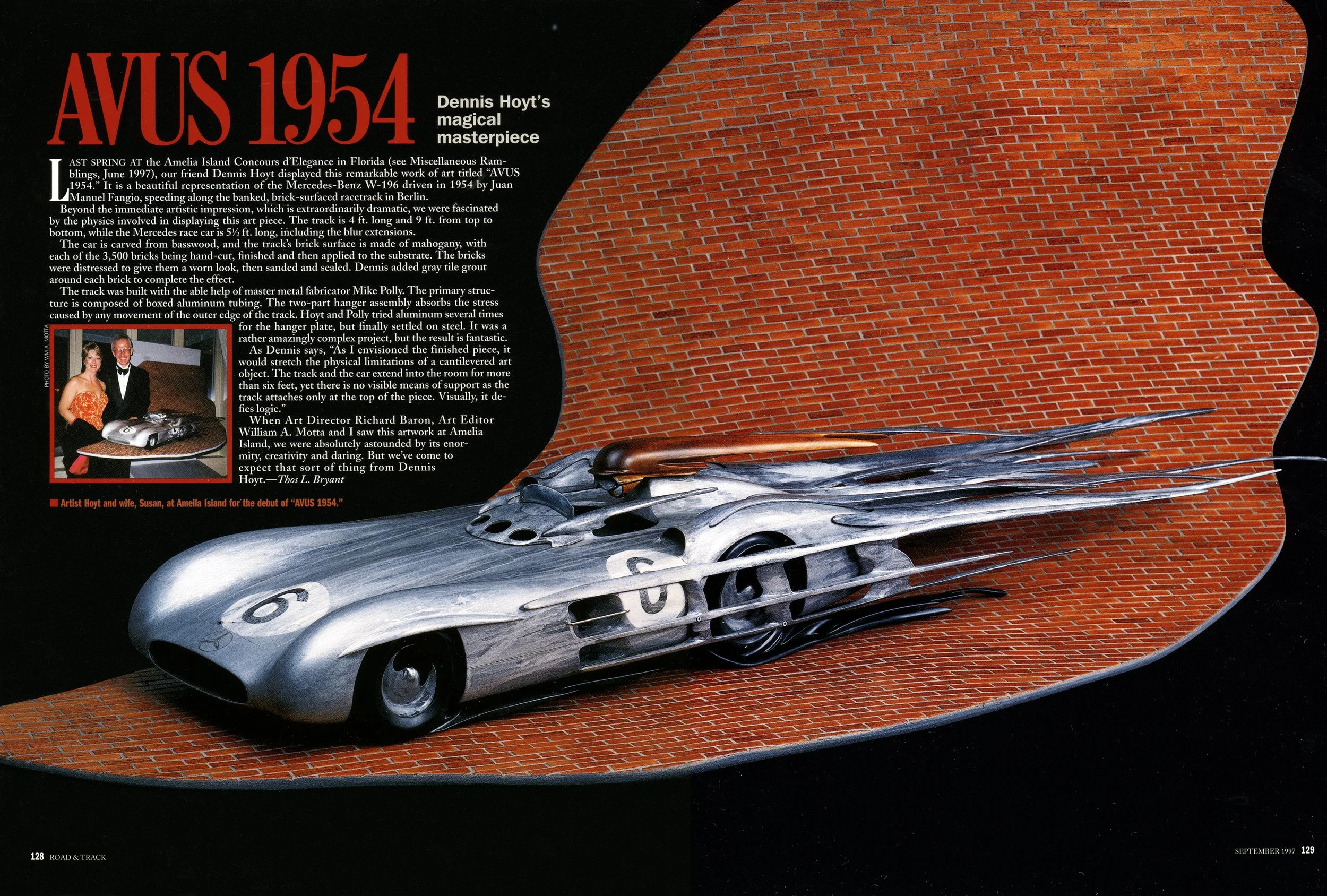
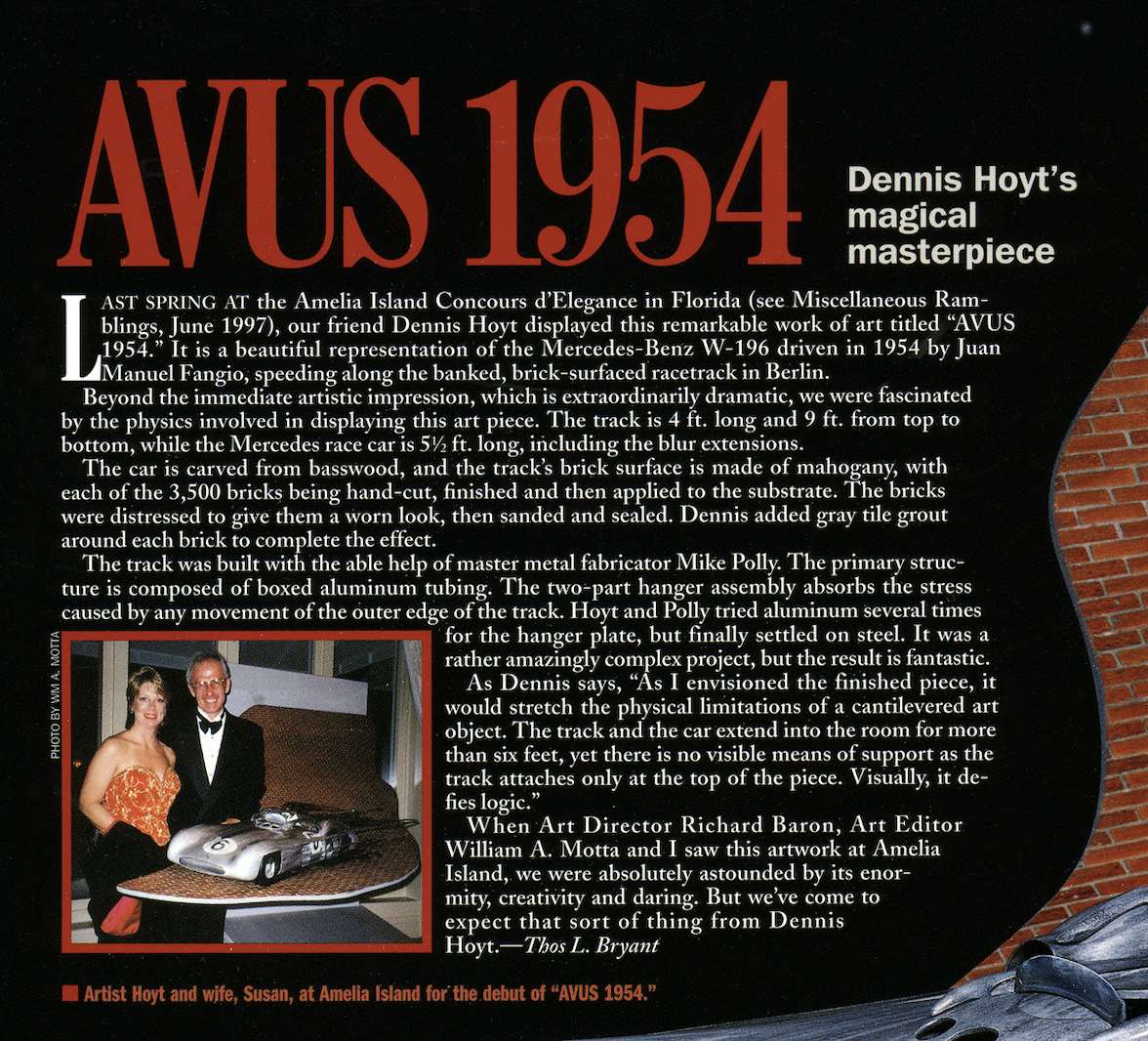
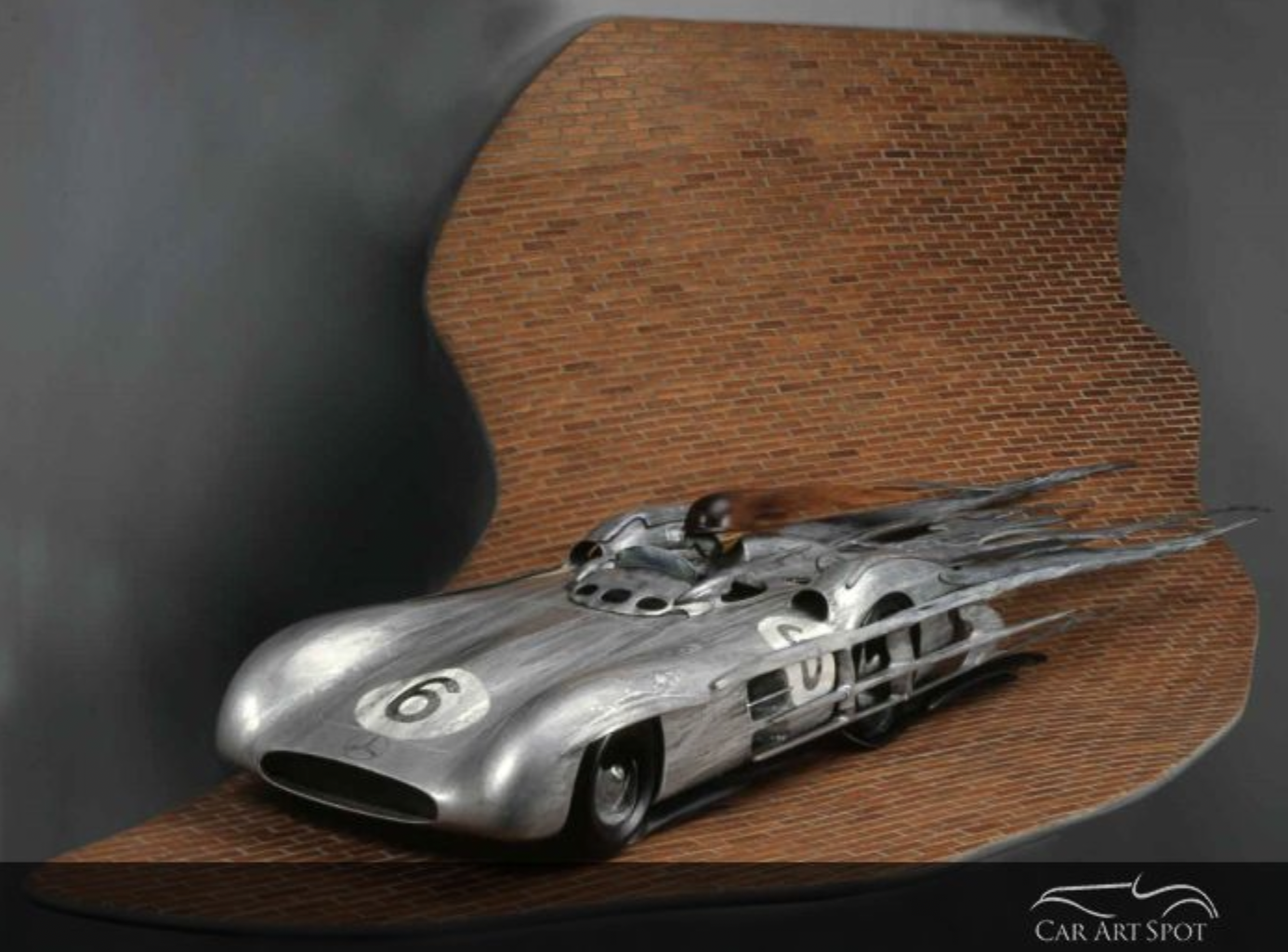
The challenges that consume me most are those of depicting various ways to create this illusion of speed in raw, visceral, immediate sense of urgency that one must feel when pushing the human limits. The use of unconventional materials is at times a real burden as I am pushing the physical limits of the materials beyond their physical constraints. I therefore look for different materials to aid in my vision. An example would be to carve a piece of wood that begins at one end with a thickness of ½ inch and reduce it to less than 1/16 of an inch over a distance of two meters, it would fail do to the nature of the material. But if one were to combine a small element of steel somewhere along the piece and at the same time make in such a way that one would not notice the transition from one medium to another. The viewer is perplexed since the limitations of the one medium is a given, how can this be achieved. This is one aspect of what I do that is so rewarding to me. One piece I call to mind is a piece done several years ago where a client wanted me to capture the essence of Juan Manuel Fangio in a Mercedes W196 coming of the high banking of a track called Avus. I created the track in such a way that it was only 1inch thick and had no visible means of support. The track cantilevered off the wall into the room 9 feet with the car at the end of the track. I had several learned men and engineers study the piece with no idea how I accomplished it. That pleased me to no end. I am always seeking ways to engage the viewer.
In terms of the future, where do you see artwork such as yours heading to?
In the future I would like to be given the opportunity to create several large-scale works that would aesthetically enhance various building, businesses, and business related venues. Sculpture that not only defines a space, but defines a client’s identity. I can envision pieces from 10 to 50 meters in length and scope. I also want to explore even further the notion of what constitutes the essence of speed. What are the particular elements of my sculpture that indicate speed and motion to those who view are most understood? I have to ask myself how can I improve these techniques and designs in such a way to enhance this reaction even more. I believe the answer lies with a more dramatic and personal involvement with the work. Involve the viewer, or client even more on a physical and emotional level. I would like to think that someday my work and ideas can help or benefit those who do not have the guidance or ability to go beyond their environment. I would like to give the disadvantaged a chance to explore new avenues or ideas, no matter where they are in the world. I would hope that given a chance I would in some small way be the inspiration for the youth of today. By opening their eyes at to all the possibilities of life if they just believe in themselves and never give up.
Arabian Homes
Do you have a passion for cars that extends beyond your art?
Yes, I have a passion for architecture, and all the mechanical aspects of making the structures work. Architects like I.M. Pei, Frank Gehry, have always been favorites of mine. Lately there has been some marvelous work by several other architects like Hani Rashid and Lise Anne Couture who created the wonderful Yas Viceroy Hotel in Abu Dhabi. This changing light ‘canopy’ is truly wonderful. There are so many truly inspiring designs now coming from the Middle East, and China that are breaking down the long held defining laws of architecture, that, in my opinion will change the ‘face’ of architecture forever. Furniture and the environment in which it is placed is also an interest of mine. How our furnishings effect us on an emotionally and spiritual level has always been interesting to me. Lately I have been working with Dr. med. Patrik Kunzler of Switzerland designing a ‘Dennis Hoyt’ line of his Limbic chair. Dr. Kunzler, a neuroscientist, and graduate of MIT, is the Director and Founder of Inno-Motion AG. His creation of the Limbic Chair was born out of combining the newest findings in neurology with modern ergonomics. Its’ goal is to enhance performance and creativity in both the work place and at home by keeping your body happy and moving while reducing spinal load and effort. Dr. Kunzler says,” we make chairs to augment your senses when you’re in them, that make you feel weightless… the same way racecar drivers need their senses augmented when they drive…..Dennis Hoyt’s art does the same thing. That is why I felt it was imperative to bring Dennis into the Limbic Chair family and combine our talents to bring something new and exciting to the world, that not only is unique but physically satisfying as well”. We are currently in the final stages of design development of the ‘Dennis Hoyt’ line of chairs. The first two designs are called, ‘The Le Mans, and the Nordschleife’ which will be available in several color patterns as well as custom designs for the client. I have also previously designed a living room suite of ‘coffee’ and end tables based on a design element of the Ferrari Testa Rossa. Also created a one-of-a-kind ‘coffee’ table for a Morgan enthusiast.
Why did you choose to work with wood?
Initially it was the material that was most readily available to me. But after considering the market and any potential competition I came to the realization that if I continued using this as my primary medium, I would be the first to develop this beyond any previously recognized limits. This I felt would lead to more exposure as I was developing new boundaries with the medium as well as my art.
Who is your target customer for your sculptures? Is it mostly art collectors or motor enthusiasts?
My primary customers have been mostly automotive enthusiasts, but I would very much like to be more associated with the art collectors. I feel the art collector as opposed to the motor enthusiast is more open to new concepts, interpretation and artistic approach to the subject matter. Often times the motor enthusiast wants a literal version of the car. In my opinion this does not ‘push the boundaries’ of what art should or could be. I will often try to explain to the client that the value of art is in the artist’s interpretation of the subject matter not the subject itself. I feel I have more freedom if I am allowed to present the subject as I see it.
Do you intend for these pieces to be displayed in homes, or a more commercial space?
I never intend my art to be displayed in any specific area unless a client wishes to draw attention to a particular space or venue. When I create pieces on speculation there is never a thought as to where a particular piece must be placed.
Commissions though are something entirely different, and considerations for placement, venue, and the desired degree of impact are imperative.
Do the sculptures require any special care to prolong their life?
There is only one thing that I impart to clients when purchasing one of my automotive wood pieces that have been dyed. Do not place the sculpture in direct sunlight. The sun will bleach the color after a period of time. Other than that, no special care is needed.
Do you take commissions for specific pieces?
Yes, I am happy to discuss any idea that a potential client might have. My objective is to create something special and unique for those who my work.
Interview with Marcel Haan
Car Art Spot
Interview by Marcel Haan
October 1, 2015
Dennis Hoyt is up each day at 4:30 and in his studio and ready to go at 5:30 a.m. "If I get an early start and get going, my enthusiasm doesn’t drop off and I can carry on all through the day", Dennis says.
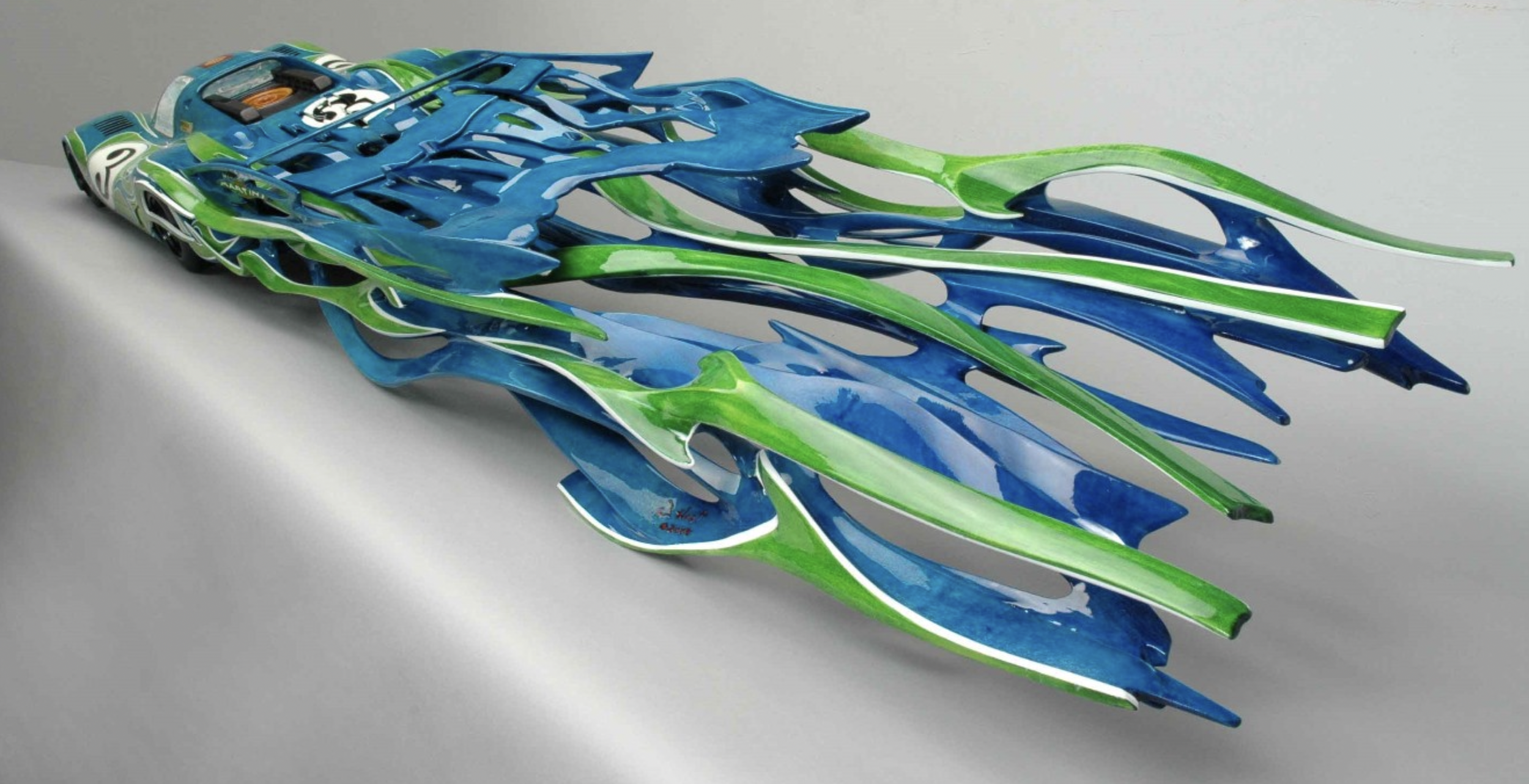
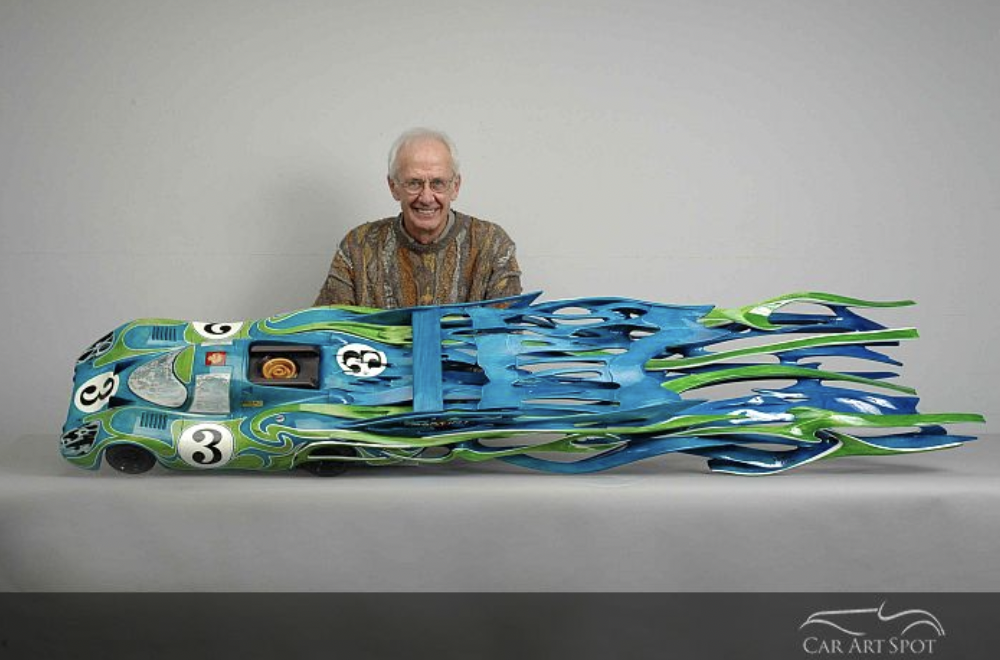
Is your Porsche 917 with the psychedelic colours, the only Porsche sculpture you have made Dennis?
No, over the years, I have done three or four Porsche pieces and in fact, my very first sculpture piece was a Porsche 911. After that I did a Porsche 956 and then a 917 and I’ve done a couple of others since. There are so many great designs and I have so many ideas but as fanatical as Porsche lovers are, a lot of them don’t seem to want to buy the artwork. Especially a large piece. But there are so many Porsches that are just classic, like the 906, 908 and the 956s. I could do so much with them and especially with this new style that I am developing. It could really be fun but it’s so difficult to sell them, so I have to be careful with my subject matter.
You do a lot of F1 and Ferrari. The Porsche 911 has the iconic design. Does having different designs, give you more flexibility as an artist?
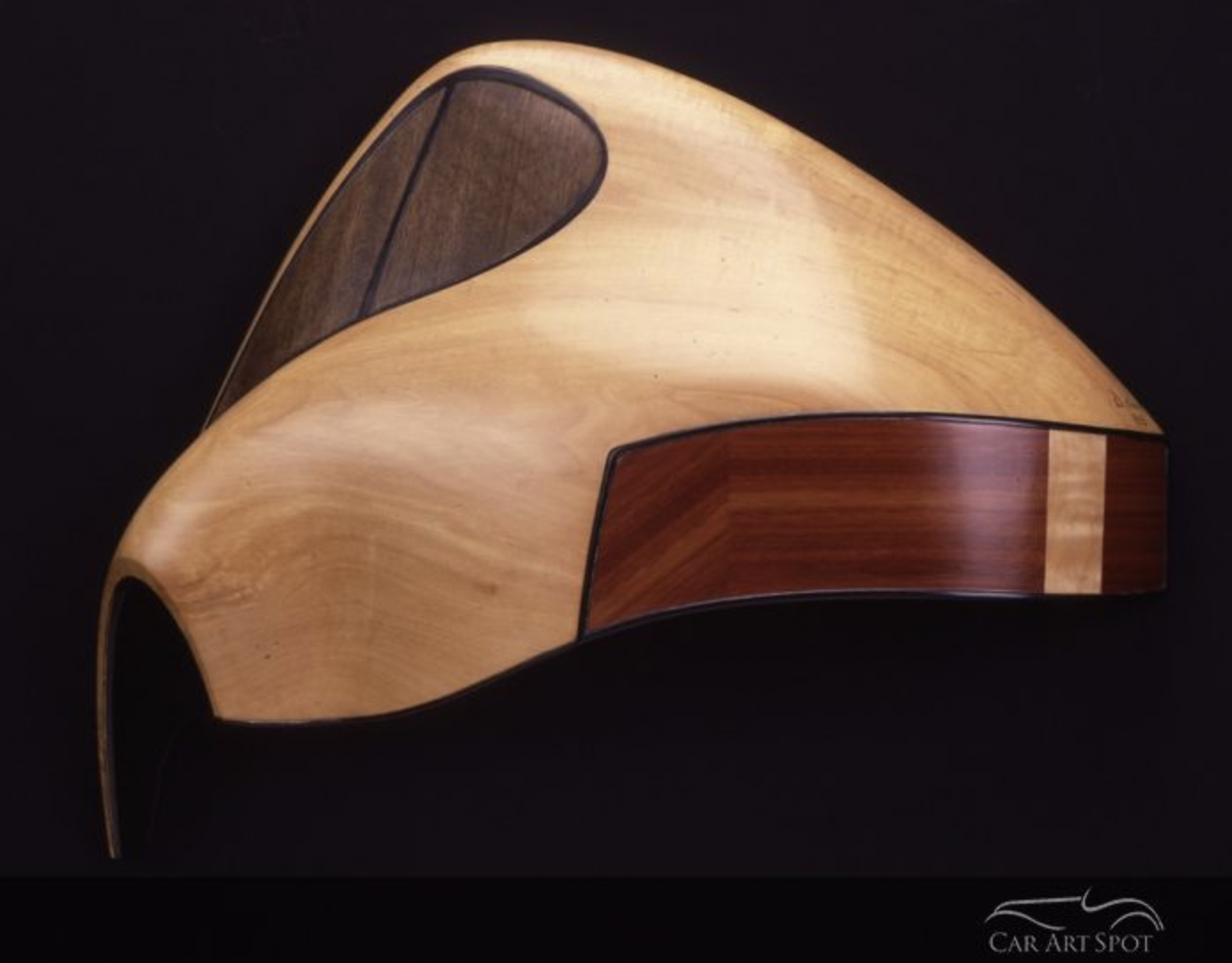
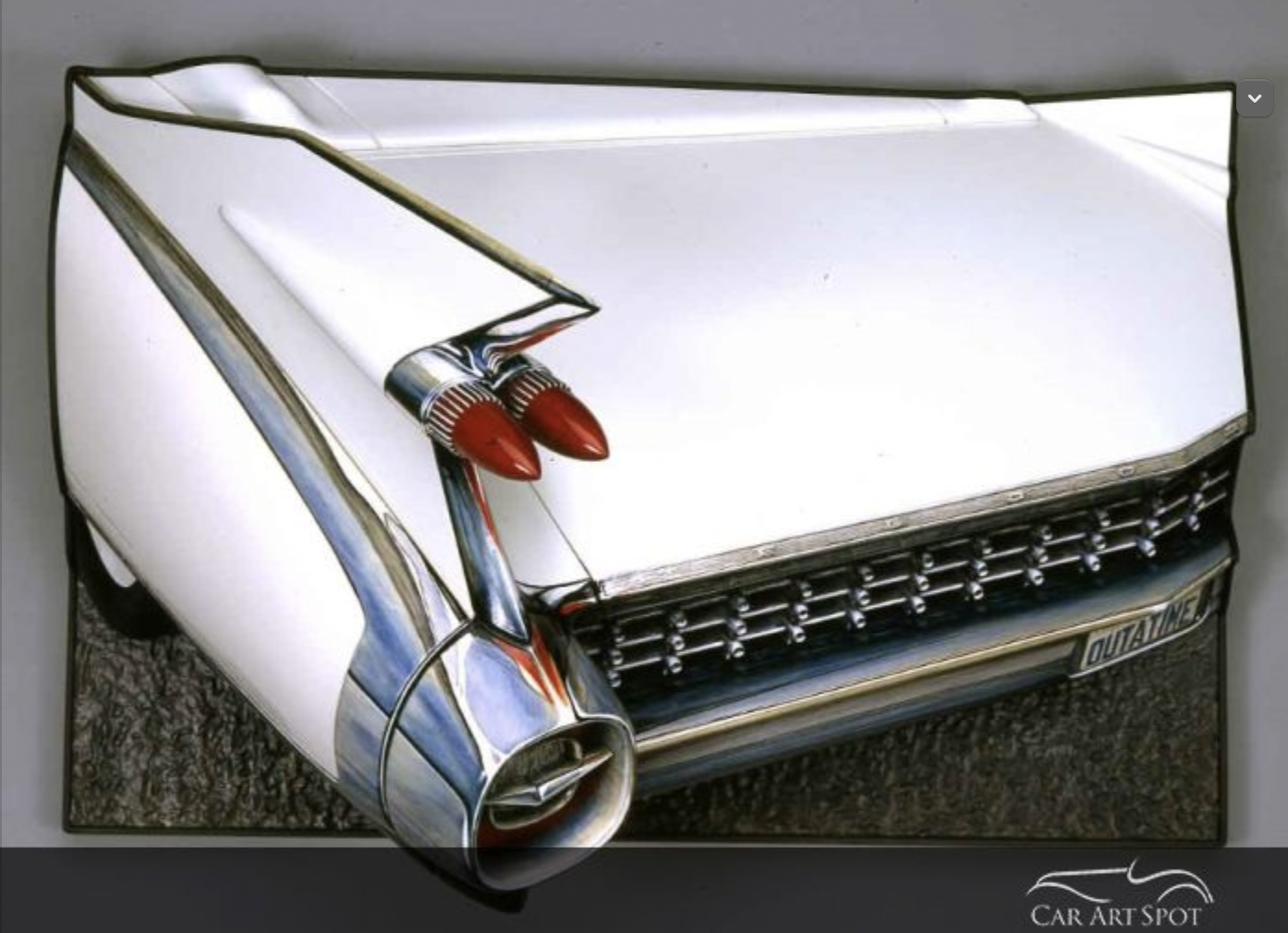
Yeah it does but with the 911 you pretty much get locked into a format. The very first piece I did was the Porsche 911 Oblique. I got the idea to do this really abstract presentation of the Porsche 911. So I found an older porsche that I wanted and I layed down behind the rear wheel and photographed part of the rear tail light, the fender up towards the front of the car. I just did that section from a very low point of perspective. So when you look at the piece, it’s a very odd shape but a Porsche person looks at it and knows exactly what it is.
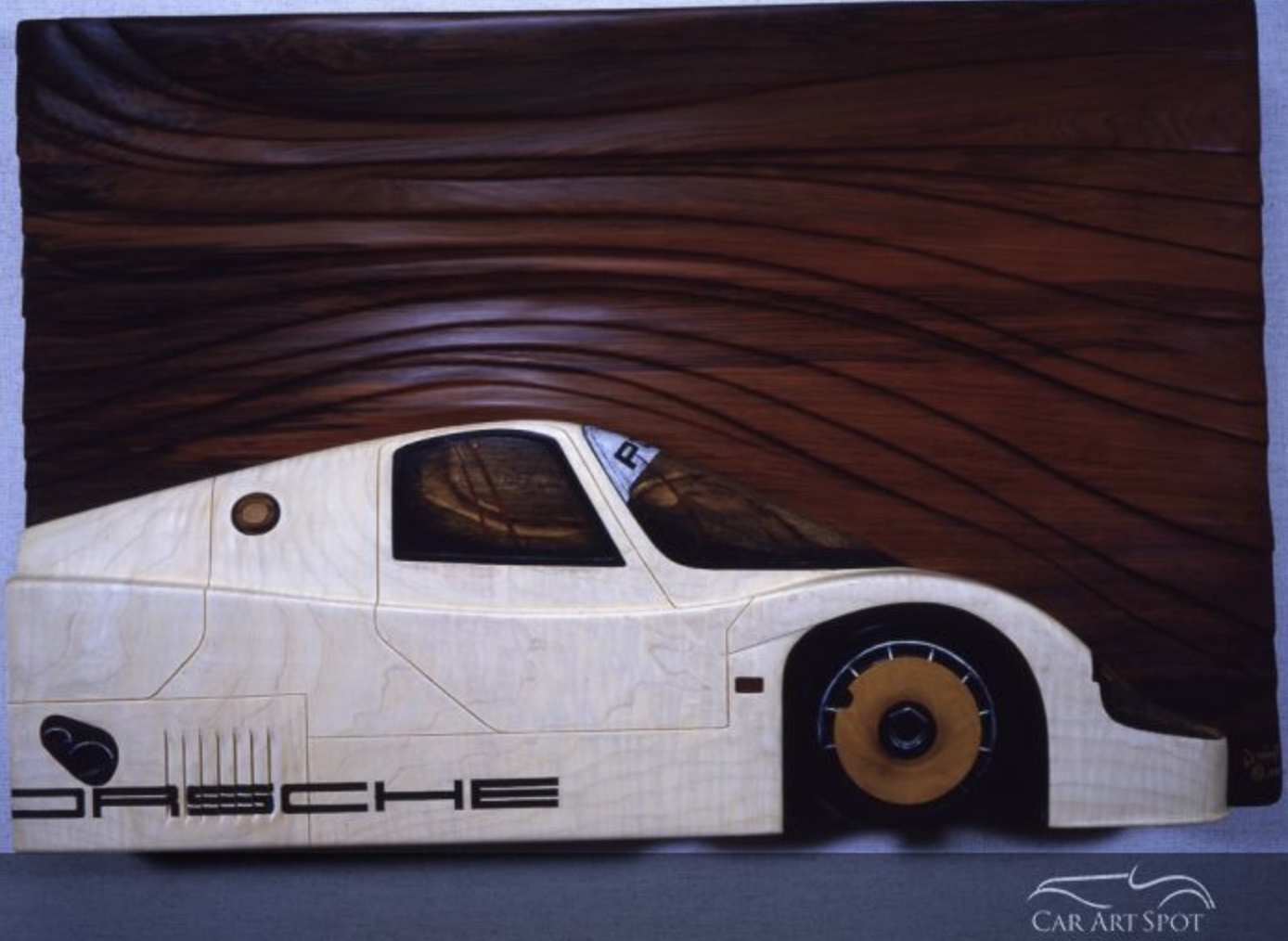
The third piece I did was the Porsche 956 at speed. I was depicting laminar flow over the top of the car. The car itself was white and the grooves that were carved into the background which the car was mounted on, were done in a dark wood. So you can see this laminar flow going over the top of the 956. I would love to do some of the newer cars in my new abstract style and several of the Porsches would lend themselves nicely to the new direction I am going in.
You did a really stunning Porsche 917. Most artists pick the blue and orange colours but you picked the other colour scheme. Was that for a reason?
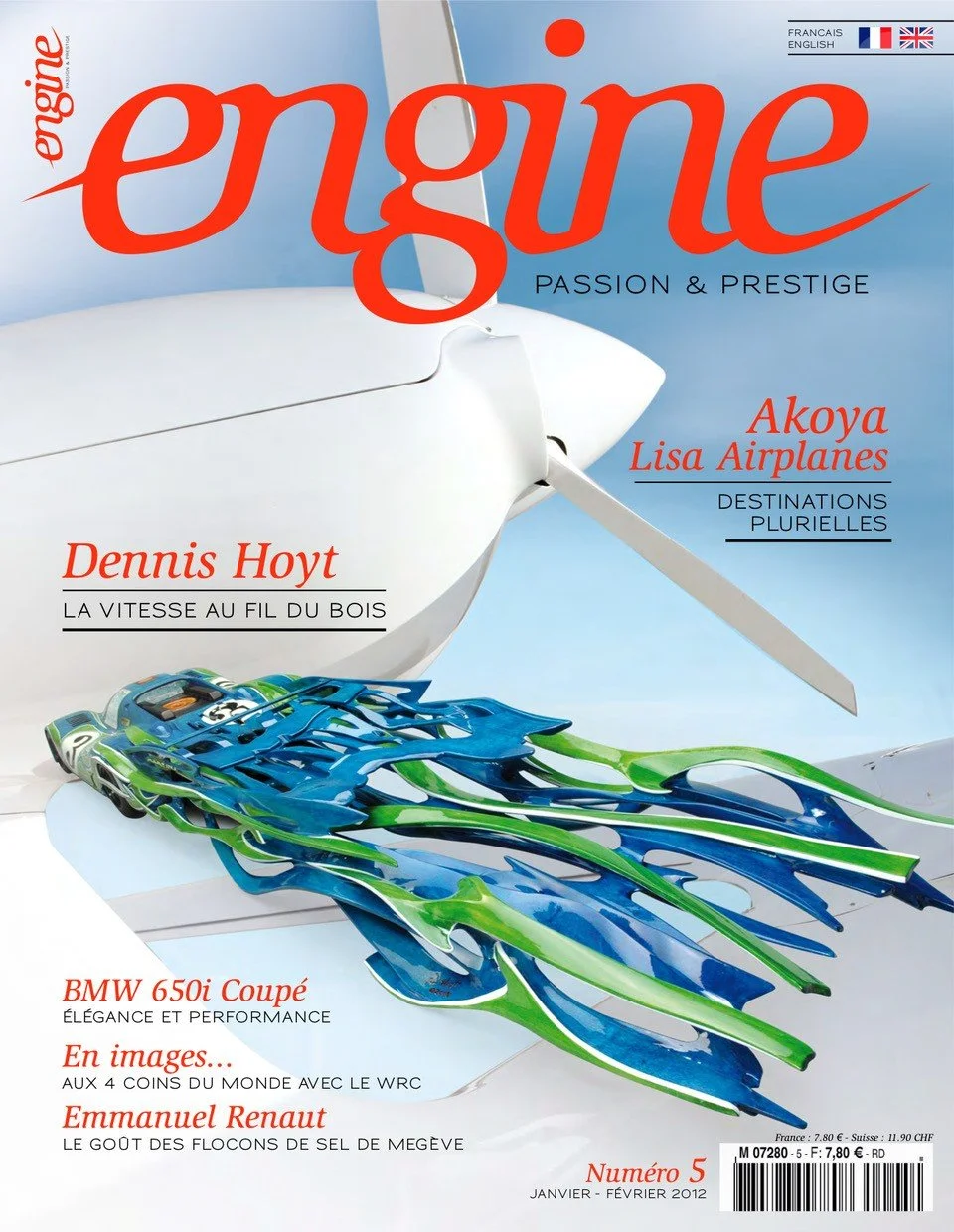
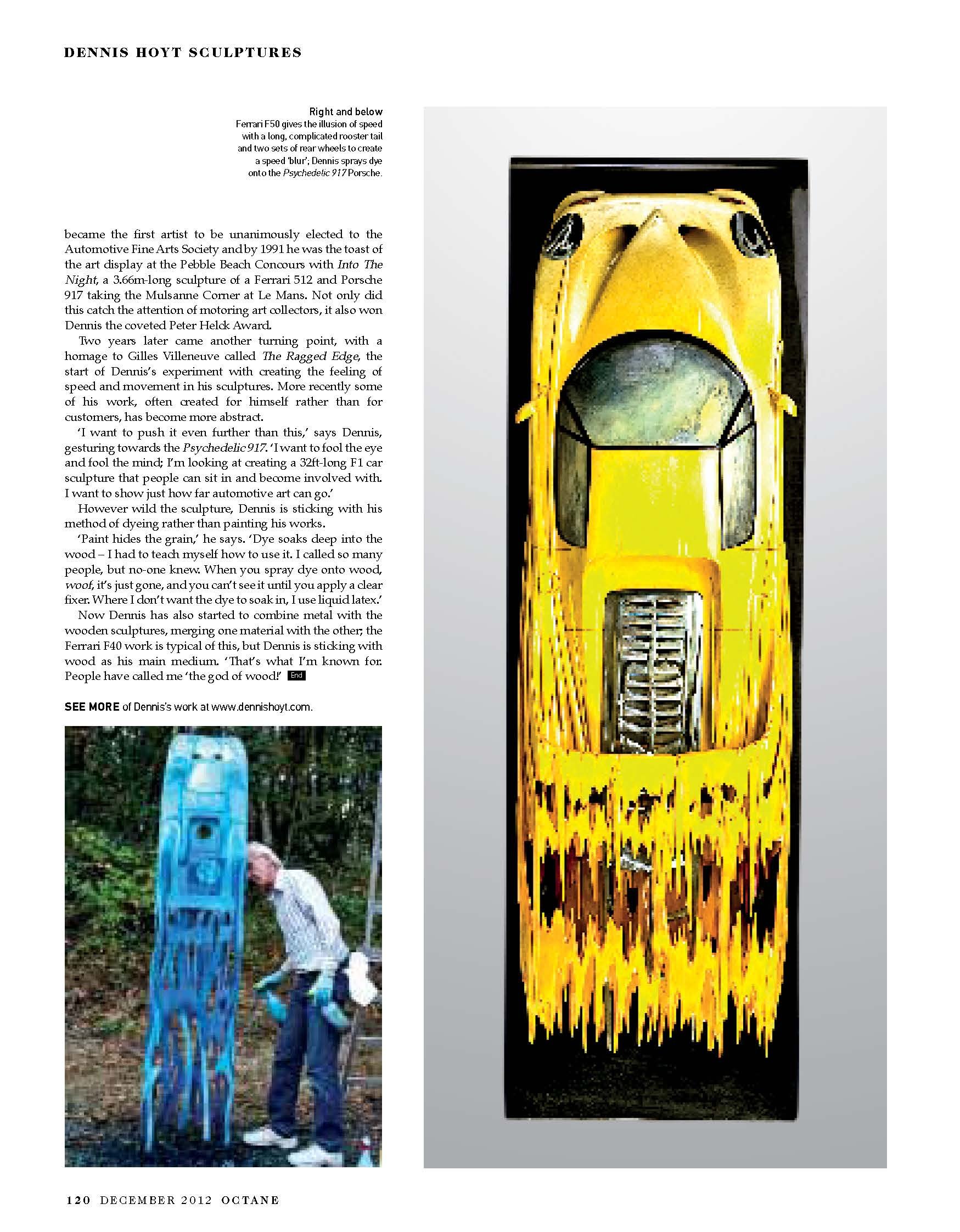
Yes, it was a commission and my client just loved the pychodelic colour scheme on the 917 (which you call the hippie car) but he wanted it to look as if it was going 200 mph. He asked me how I would do that. I looked at the paint scheme and said ‘to me it’s very simple. I would extrapulate the paint behind the car and just elongate it and exaggerate it’ and he said ‘great, just do it’. And that’s how it came to be. I made that sculpture from two separate pieces of wood and it was extremely intricate in the way that I intertwined all the pieces. I worked for months on it and it was a two month process just getting all the colours exactly right.
After putting so much time and effort into doing a piece like that, isn’t it hard to see it leave your studio.
By the time I had finished that piece, I just wanted to finish it and get it done. So I didn’t have a problem letting it go to the client. Then the piece was sent back to me to take to Bahrain last year and when I opened the crate and saw the piece after 10 years, I thought ‘wow, did I do this’? Then I did feel sorry I had sold the piece. Everyone who saw it in Bahrain was blown away by it. They couldn’t believe it was made out of two pieces of wood.
When you do a Porsche, how much study and research do you put into it?
With that particular piece, I did a lot of research and investigation and in particular to the colour because I couldn’t find the exact true colours anywhere on internet or in photos. I eventually found and ordered a book from Japan with a full page spread of the Porsche 917 when it was in the pitts during the race with it’s tail end up because they were doing some work on it. That showed me right there the true colours because I could see the correct florescent orange red emergency kill switch which all the cars have. It also showed me how the stripes over the body widened out at the rear. To this day, cars which have been repainted are correct in every way with the exception of the stripes. They paint them the same width going over the whole length of the car, when originally they should widen out at the rear. So if you don’t have that photo, you don’t know that because most people take photo’s from the front or side or back of the car and not overhead of the car.
What about the dimensions of the car. Do you have the technical drawings of the car then?
I go to a couple of good websites which have the blueprints of cars. They are not always the most accurate but I get the dimensions, take a copy of the blueprint, scale it out, make a paper template and continue my process to get the dimensions exactly right. A lot of sculptures that you see of that car are not as wide as the car should be and some are also shorter than the car really was. It was a long tailed car.
The car itself became quite an inconic car with Steve McQueen and the movie Le Mans. Did it have more meaning for you that just being a commission?
Oh yes because I think that car represents the battle between the Ferrari and the Porsche during the 1970’s and the long tailed cars which were only a couple of years like that. I think the high point in the Le Mans race was that the cars were extremely pretty because of their graceful long silhouettes. That represents to me one of the hallmarks of the Le Mans type racing. There have since been other cars which have done equally as well and are nice but in the 70’s THAT was IT. THAT was the car! The car is currently owned by Dr. Simeone in Pennysylvania. He has done a really wonderful job in setting up a great museum, showing all these wonderful classic cars from all the premieres but he kind of stages them in the setting which is appropriate to when the cars were in the pitts at Le Mans. He goes after some really unusual and highly regarded Formula racing cars. He’s got Ferrari’s and Alphas and everything else but they are always the number 1. He’s a marvellous guy who raises a lot of money for childrens’ charities.

Interview with Marcel Haan
Dennis Hoyt was invited by His Highness, the Crown Prince of Bahrain and Sheikh Salman (CEO of Bahrain International Circuit) to give a solo exhibition of his work in Bahrain. Drawing in 20,000 people in just three days, it was an overwhelming experience.
How are you Dennis?
I am working feverishly but I'm fine.
Are you working to a deadline?
Well I have a tentative schedule date for an exhibit at the Formula 1 race in Texas in October and I had an exhibit in Bahrain last April and they want me back. So I am doing a multiple show effort here and my agent is now also arranging something else for me concerning my new project.
So are you coming up with something new for the forthcoming exhibitions?
Yes. Everything's going to be brand new. In fact you are one of the first people to actually share that. I'm taking a whole new direction in my art. I'm going away from what most car artists do and away from what car people like to see, which is some sort of a literal representation of an automobile. I'm going to where my heart and my passion is and that's abstract impressionism. I don't know if it will be successful but next year I will certainly get a lot of attention because it's something totally different from what I've ever done before. I've always felt that automotive art should be an interpretation of the automobile and not a literal presentation of it. So that's the direction I'm going in and it's actually where my true heart is.
Okay, but will the topic still be the car?
It will still be the car and I don't want to say almost unrecognizable because you will recognize certain aspects. But I'm more interested in the passion, virility, speed and motion that the automobile conveys and I'm trying to show that in a whole new three dimensional format.
That's going to be very interesting because you already do your work in an abstract way. Have you already started making something?
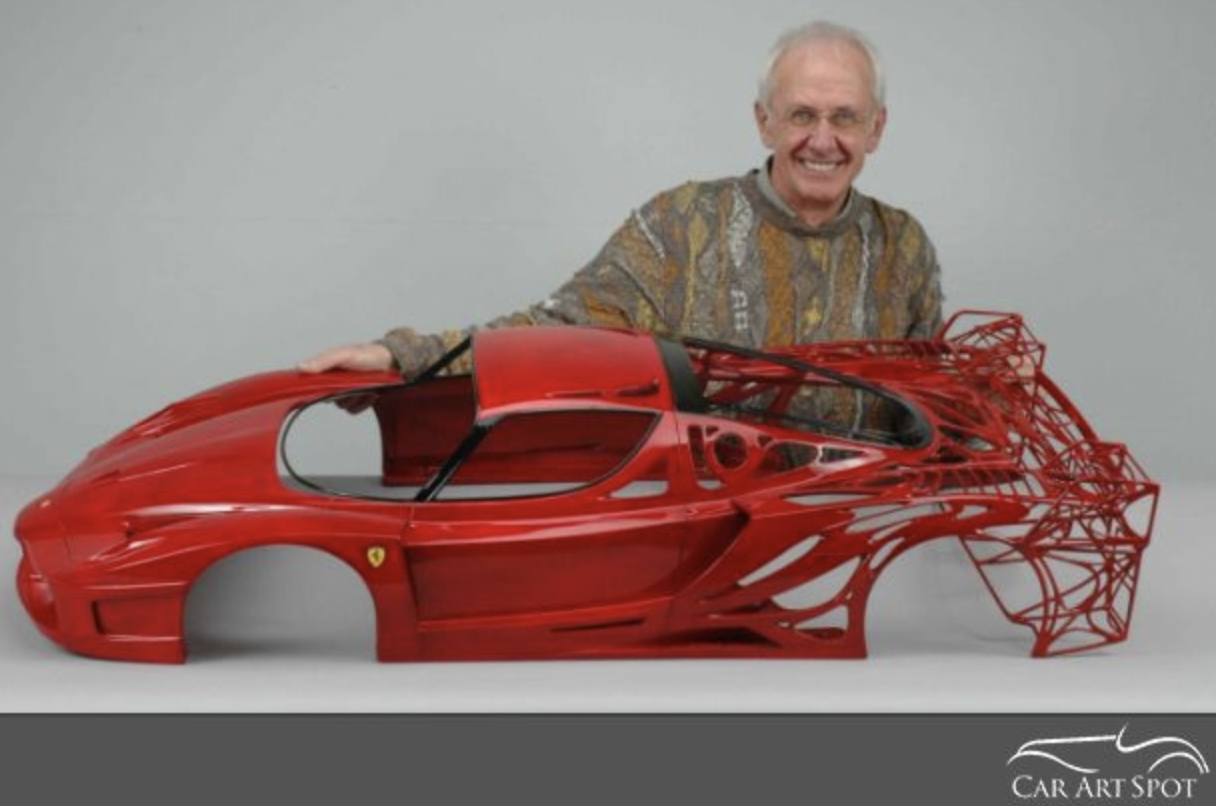
I finished my first piece in time for the show in Bahrain and it was a tribute to Ayrton Senna. One of the things said about Ayrton was that he was a very colourful individual. So I just tried to play off of that idea and focus on him but you can get an indication that he's in a McLaren. I'm working on a second piece which is even more abstract and consists of about 50 pieces of wood.
How does the process work Dennis?
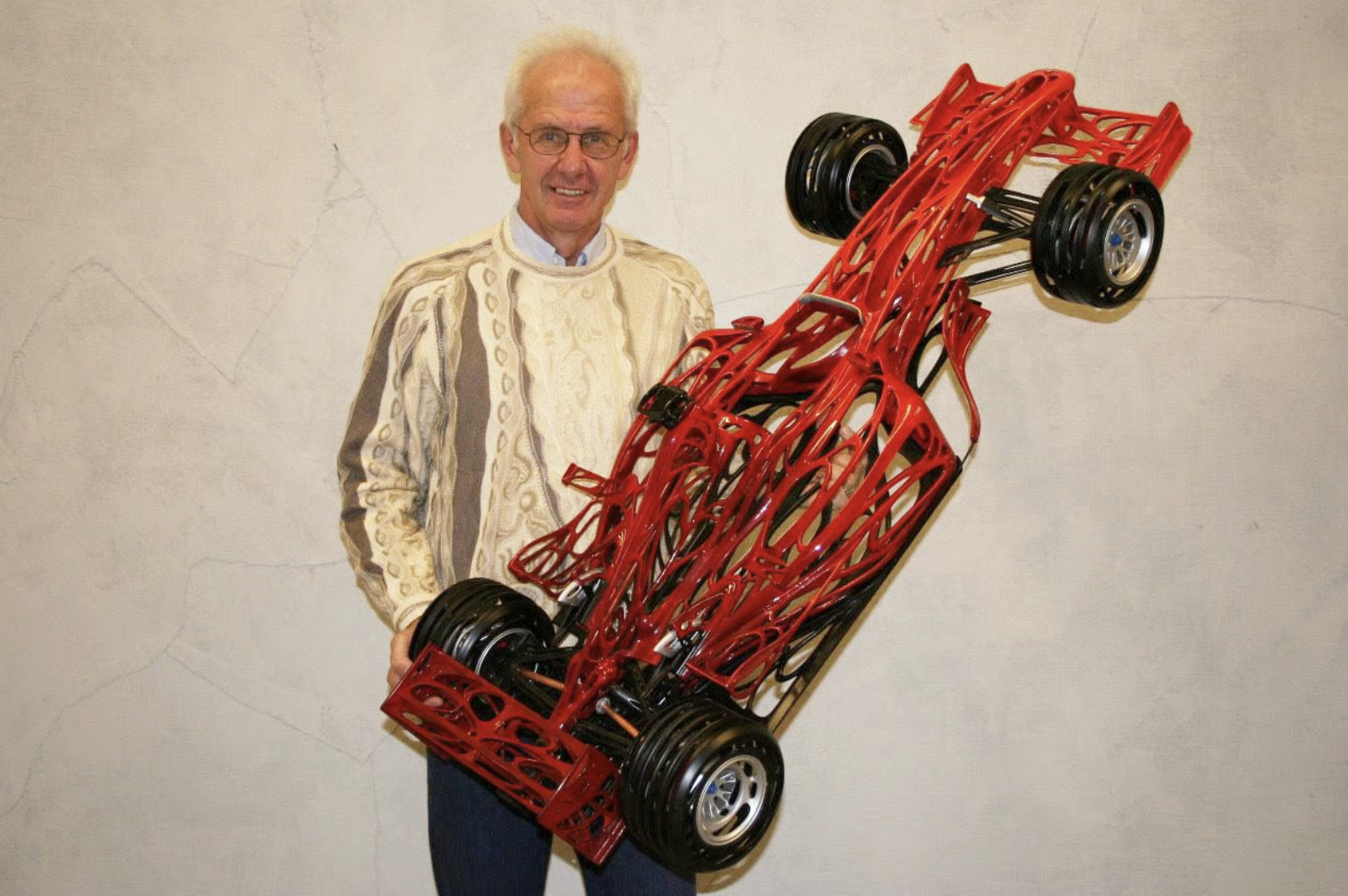
I've never before sketched anything other than what a client would like to have sketched. But this time I sat down and took a look at several images to get a mental impression of what I want to do. I then just started doing free hand sketching and once I got the sketch comprised of how I felt my impression of the car was at speed, I started carving the pieces. I started with two or three basic pieces and just kept adding onto that and interlocking them. It's a very free form three dimensional piece and it will be about 5.5 feet long (a little over 1.5 m) and it's about 24 inches high. It's wall hanging and I will be focusing on doing some wall hangings, as well as free standing pieces. But they are going to be significantly different from what anyone has ever seen from Dennis Hoyt before.
I really like how you develop and don't stay with just one style. Obviously your current style is popular with the audience but you are taking it to another level because as an artist, you have to.
Yes exactly and I get really bored if I have to do a similar thing. I've taken my previous works as far as I can take them. I now really want to push beyond that and develop new ideas and also the uses of materials. I felt that I was constrained by the format that I had previously established. I agree with you 100%, in my opinion an artist isn't an artist unless he constantly evolves and moves and changes.
Does it also challenge your craftsmanship then? Is your new style more difficult to make?
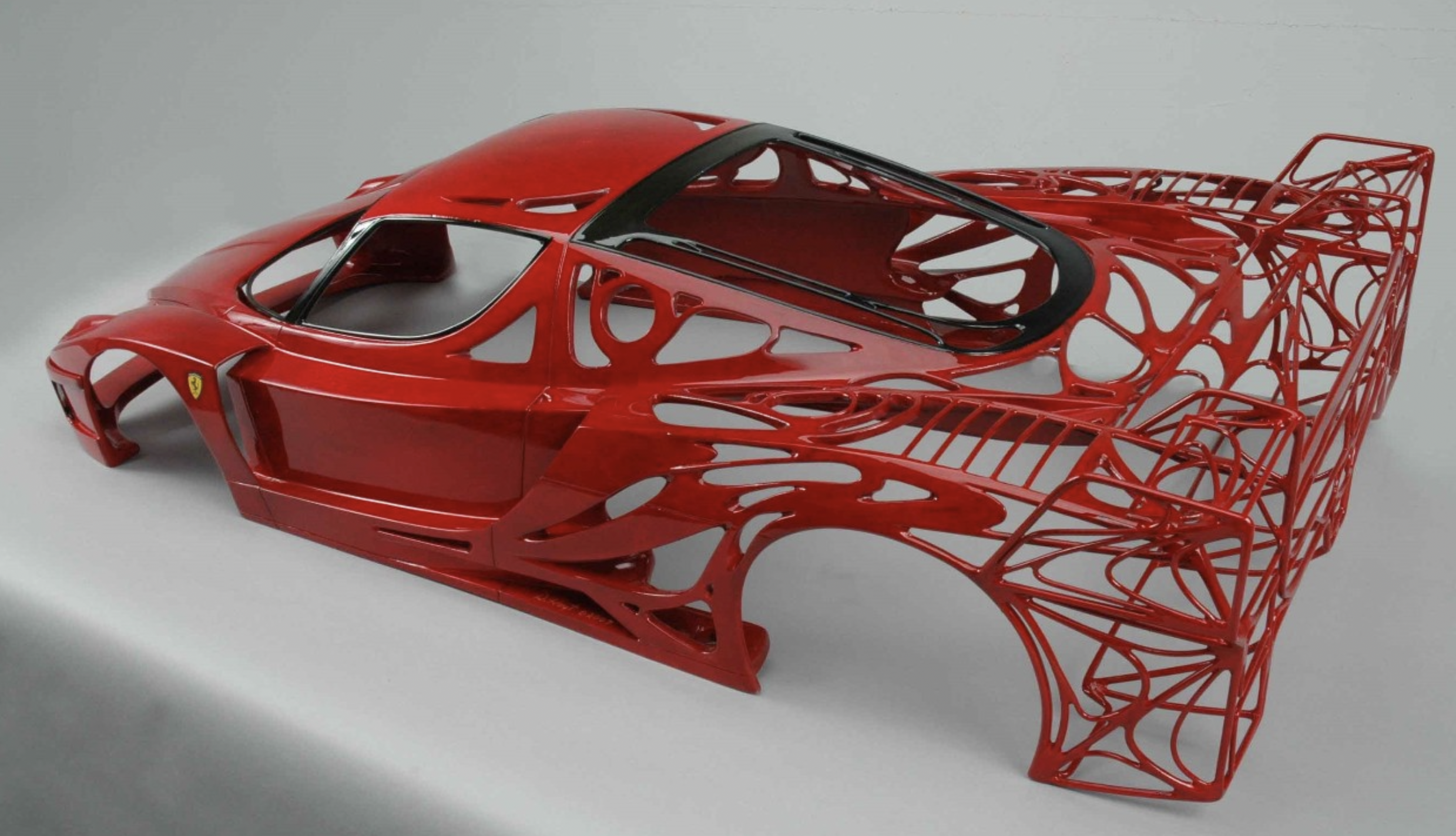
Yes it is because I am having to look at this now in a whole different context as far as the mechanics go. How to make the pieces fit together and not show any digital means of connectivity. So that the wood, for example on the piece which I am currently working on, is tied together with steel rods here and there but are embedded into the back side of the wood. When you view it, you don't see anything other than wood but structurally there's this steel membrane that's working through the back of it to hold it altogether.
You just mentioned that you start off with sketches. But sketches are too dimensional because they are still on paper. So how does it translate to your 3D sculptures?
Well what I'm doing with this piece now is, I'm only using the sketch as a pattern or layout pattern. As I start carving and shaping the pieces of wood, I think 'well why can't this part rise here' or 'why can't that have an indentation there'. Then I just start letting my mind go and not sticking to any formula as far as how the pieces should fit dimensionally, or how it should connect. So I'm being free with the shapes. Even though it might have the dimensional outline of the 3D sketch, it can end up how I feel on that moment.
Are you working with natural material?
It's all basswood.
Does the wood structure also play a part in what the structure becomes?
Yes it does and there are limitations which I am now trying to overcome. For example, wood has a lineal grain pattern to it and if you cross that grain, it's significantly weaker. I want to keep the wood grain pattern constant, so what I do is I grout a very fine channel in the back of all these pieces and put in steel rods and wires of different dimensions. This maintains the structure and I still have that grain pattern that follows through.
Wow, a lot of skill and technique is needed for that.
Yes that's right and it's trial and error.
I can imagine that sometimes things break and this is why you have come up with the enforcement structure.
Exactly. My ideas allow my mind to be free as to what the shape could be like. Then I figure out a way so that when it's viewed by the customer or the audience, they cannot see how it is done. The pieces overlap and intertwine and I use this because again, I think it depicts motion and speed and virility. It also has a very tactful feel to it and I like the idea of high contrast and the fact that I'm not working on a one or two dimensional surface. I try to make the most of the 3D aspect. It opens up a whole different area in my mind because I'm not confining myself to any given law of how the wood should be put together.
So what is it that you want to express with your art Dennis?
What I want to express is what really gets me excited; how to interpret the idea of speed and motion in 3D. How many ways can you express the virility, the passion, the movement and motion and all of the things that go into making an automobile go very fast. I want tension within the piece, I want grace within the piece and yet I want this underlying feel of 'my God it's coming apart' or 'my God it's going 150 miles per hour'. This is what I'm trying to do now with the shapes and also with the colours. My current piece is going to different from before because then I used one or two primary colours in my work. Now it's going to be multi facetted because of multi colours. I want to have different values and different levels of colour values within two or three pieces of wood. So you get again another dimension from the 3D effect.
My new piece will be unveiled in April in Bahrain. There are no limits to where I see my new direction going. I can visualize pieces that are 30 meters long and 15 meters high. You can't do that by doing a literal version of something. I want to take it beyond that. I want to explode the whole idea of what automotive art can be. The thing is, I don't want to call it automotive art. I just want to call it art.
I think by hanging the name automotive art on it, you put it in the niche market and limit its' appeal. Plus the mainstream art world will shut the door as soon as you say the word automotive art. This has been my experience now for twenty years. The art market has changed in the last four or five years in that a lot of the people who were buying automotive related art are no longer doing that. The younger generation aren't so interested in automobiles and therefore, there's less interest in automotive art. You find a lot of automotive artists standing on the side lines wondering what to do next. So I've gone my own way. I don't know if I will be successful but I just need to do it. I can't continue to do the things I've done in the past.
The French impression artists followed their heart and went against the mainstream and look how that turned out. So I think you are right to follow your heart Dennis.
I hope so and I'm not going back to what I did before. Whether it will be commercially successful, I don't know. I just have a gut feeling that it will be because it opens up a whole new market. On my current new piece, I've got three small more pieces to detail and then I will bleach all of the wood and start the colouring process of dying the wood. Then I'll put a sealer on it and after that, do an assembly.
And you are bringing it to the automotive exhibition?
Yes. Bahrain invited me last year and want me back. Bahrain is the first international country who has asked me to do a solo exhibit. I told them that because they were the first, I would introduce new pieces next year. They talked about me coming back in January to do a lecture to students and then to come back in April to show the exhibit during the F1 race.
You are the only one doing this. Do you feel inspired by other artists?
Some of my favourite past artists are Pollack, Alberto Giacometti. There have been some artists from the past who I really admire and there are some new artists who sometimes produce something which I think is really good. But most of my inspiration comes from watching the cars at speed and seeing the blurred motion of colours and that's what I try to capture. What the motion looks like two hundredths of a second after it's gone by. This is how my mind is constantly working.
So how do you capture those moments?
I just see them in my minds' eye and I try to replicate them. That's what I am doing with my new work as well.
Do you go to a lot of races as a spectator?
Not really. I don't go to that many because I am mainly in my studio working. I would like to attend as many F1 races as I could, and I would love to be at Le Mans one day but so far, I've not had the time to do that. The Bahrain F1 was fantastic and the people were wonderful. I enjoyed myself immensely. They treated me like royalty. I received 20,000 people in three days. It was absolutely unbelievable the amount of people who came through the exhibit area. So I was just overwhelmed by it all.
That was your solo exhibition?
Yes it was by invitation of the Bahrain International Circuit and by the Crown Prince of Bahrain. I had an audience with His Highness, the Crown Prince of Bahrain and Sheikh Salman (CEO of Bahrain International Circuit) and a couple of others and of course Mr. Ecclestone. It was an overwhelming experience for me but I got the taste of it and I love it. So I want to go back.
I can imagine and that it will help you go forward with your ideas of larger dimensional sculptures.
Exactly and that's what my wish is; for people to start realizing that there is a large area where we can really be creative with materials and do something that the world has never seen before. I've done a lot of research on the internet and I'm not doing what other people are doing. I don't want to be like everybody else or do what everybody else is doing. As soon as I see something that is kind of like what I visualize, I think nope I'm not going there and I change it.
Is your style being copied?
Oh yes. I'm seeing more and more people doing the style that I've been doing for ten or fifteen years. So now it's time for me to move on and leave them to do what I was doing fifteen years ago.
It's pretty unique because you are combining wood techniques with painting as well. How did that develop? Did you have an education for that?
Well I actually got pretty bored with all the art schools and dropped out of almost all of them. To me, what they were trying to teach was all rudimentary. I understood all that and wanted to move on. I had the idea that I wanted to learn something different and they weren't teaching that. I was very impatient from an early age and then when I started doing my carving and sculpting of cars, I started looking at ways to change the appearance and then thought of colour. I did a lot of research on different types of colouring processes. I finally settled on dyes which allow the wood grain to show through and I can get all these marvellous wonderful colours. I found that I could mix them with a lower grade of alcohol and it would give me the colours I wanted. I tried Ukrainian egg dyes, food dyes, everything I could get my hands on. I couldn't ask anyone because no-one had done that before. So it was trial and error and I was actually buying dyes from ink manufacturers because you couldn't get them any place else. Now 15 to 20 years later, there are a lot of people making dyes.
The challenge for many artists is that once they have a steady income, it limits them to take risks.
Exactly. When my new work comes out next year, you will see that it's different from what anyone else is doing.